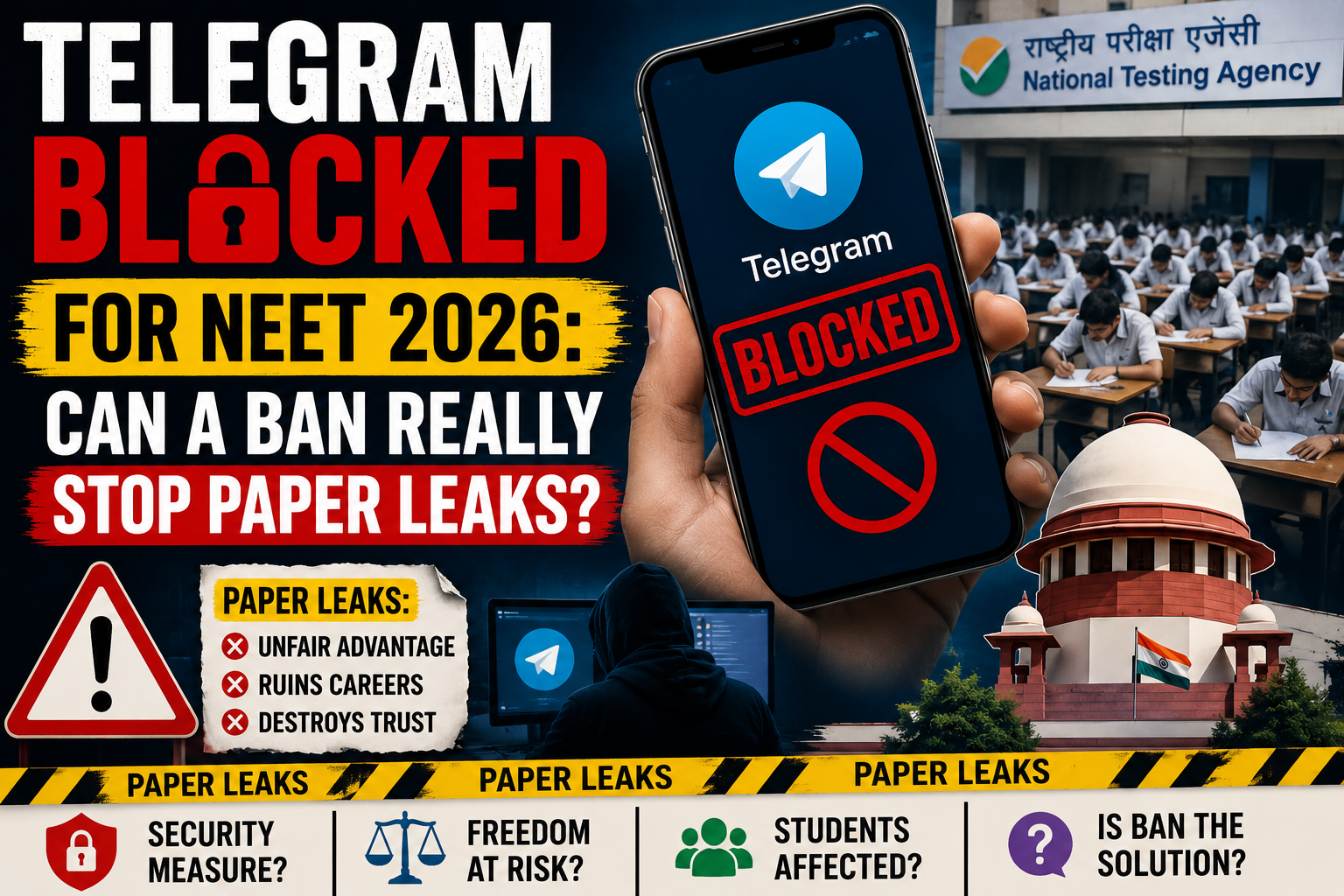
The Indian education system is currently facing its toughest challenge yet. Following the massive controversy surrounding the initial medical entrance test, reports suggest that Telegram Blocked for NEET 2026 discussions are gaining momentum among policymakers. This move comes as a desperate attempt to curb the circulation of leaked question papers and maintain the sanctity of the upcoming re-examination. However, the big question remains: Can blocking a messaging app truly solve the deep-rooted issue of paper leaks? In this article, we analyze the impact of this potential ban and the ongoing struggle for a transparent examination process.
Why is Telegram Blocked for NEET 2026 Being Considered?
The idea that Telegram Blocked for NEET 2026 might become a reality stems from how leaks occurred in the past. Specifically, investigators found that several Telegram channels were used to sell leaked question papers to thousands of students for lakhs of rupees. Because Telegram offers end-to-end encryption and allows large groups, it has unfortunately become a preferred platform for unscrupulous elements. Consequently, the government believes that restricting access to such apps during the exam period could prevent the rapid spread of sensitive materials.
This situation is not isolated. If you have been following the NTA Re-Exam Portal Under Scanner updates, you know that technical vulnerabilities have already compromised student trust. Therefore, the authorities are now looking at every possible angle, including social media bans, to ensure the NEET UG Re-Exam City Slip 2026 Soon leads to a successful and fair test.
Can a Social Media Ban Really Stop Paper Leaks?
While the thought of Telegram Blocked for NEET 2026 sounds like a quick fix, experts argue that it might only be a surface-level solution. Paper leaks often happen at the source—either during printing, transportation, or at the exam centers. Therefore, blocking an app might stop the distribution to the masses, but it does not stop the leak itself.
Furthermore, tech-savvy individuals often use VPNs (Virtual Private Networks) to bypass such bans. If the root cause of the NEET 2026 paper leak is not addressed through better physical security and digital encryption, students will continue to find alternative ways to share information.
Comparison: Physical vs. Digital Security Measures
| Security Layer | Potential Weakness | Proposed Solution |
| Messaging Apps | Rapid, anonymous distribution of leaked content. | Telegram Blocked for NEET 2026 during exam hours. |
| Exam Portals | Vulnerabilities like the NTA Re-Exam Portal Hacked claims. | Enhanced cybersecurity audits and 2FA. |
| Physical Papers | Theft during transportation or from local centers. | Digital question papers with time-locked passwords. |
| Center Integrity | Involvement of local staff in malpractice. | Centralized AI-based CCTV monitoring. |
The Impact on Students and Legitimate Communication
If Telegram Blocked for NEET 2026 is implemented, it could also affect thousands of students who use the platform for legitimate study groups and doubt-clearing sessions. Specifically, many teachers use Telegram to provide last-minute tips and RE-NEET 2026 resources. Consequently, a blanket ban might hinder those who are preparing honestly.
Moreover, this uncertainty adds to the existing stress of aspirants who are already dealing with the JEE Advanced 2026 Data Leak news and other academic disruptions. Therefore, the government must balance security needs with the rights of students to access information.
What Should Students Do Now?
As the debate over Telegram Blocked for NEET 2026 continues, students should not rely solely on one platform for their preparation. Here are a few strategic tips:
1.Diversify Resources: Use official apps and websites for your study material.
2.Stay Updated: Regularly check Daily Job India for verified news instead of trusting anonymous Telegram messages.
3.Focus on Preparation: Don’t get distracted by rumors of bans. Your primary goal is to clear the NEET UG Re-Exam.
4.Report Malpractice: If you see any suspicious activity or “paper selling” claims, report it to the authorities immediately.
Conclusion
To summarize, the possibility of Telegram Blocked for NEET 2026 highlights the desperate need for systemic reforms in our examination process. While a ban might provide temporary relief, the long-term solution lies in building a foolproof digital and physical infrastructure. Whether it is fixing the JEE Advanced 2026 Result Portal or securing the NEET re-test, the authorities must act with transparency. For more updates on the SSC GD Constable Answer Key 2026 and other government jobs, stay connected with us.
Final Words: A ban is just a tool, not a solution. The real victory for students will be when they can take an exam without the fear of leaks or scams. Stay strong and keep studying!