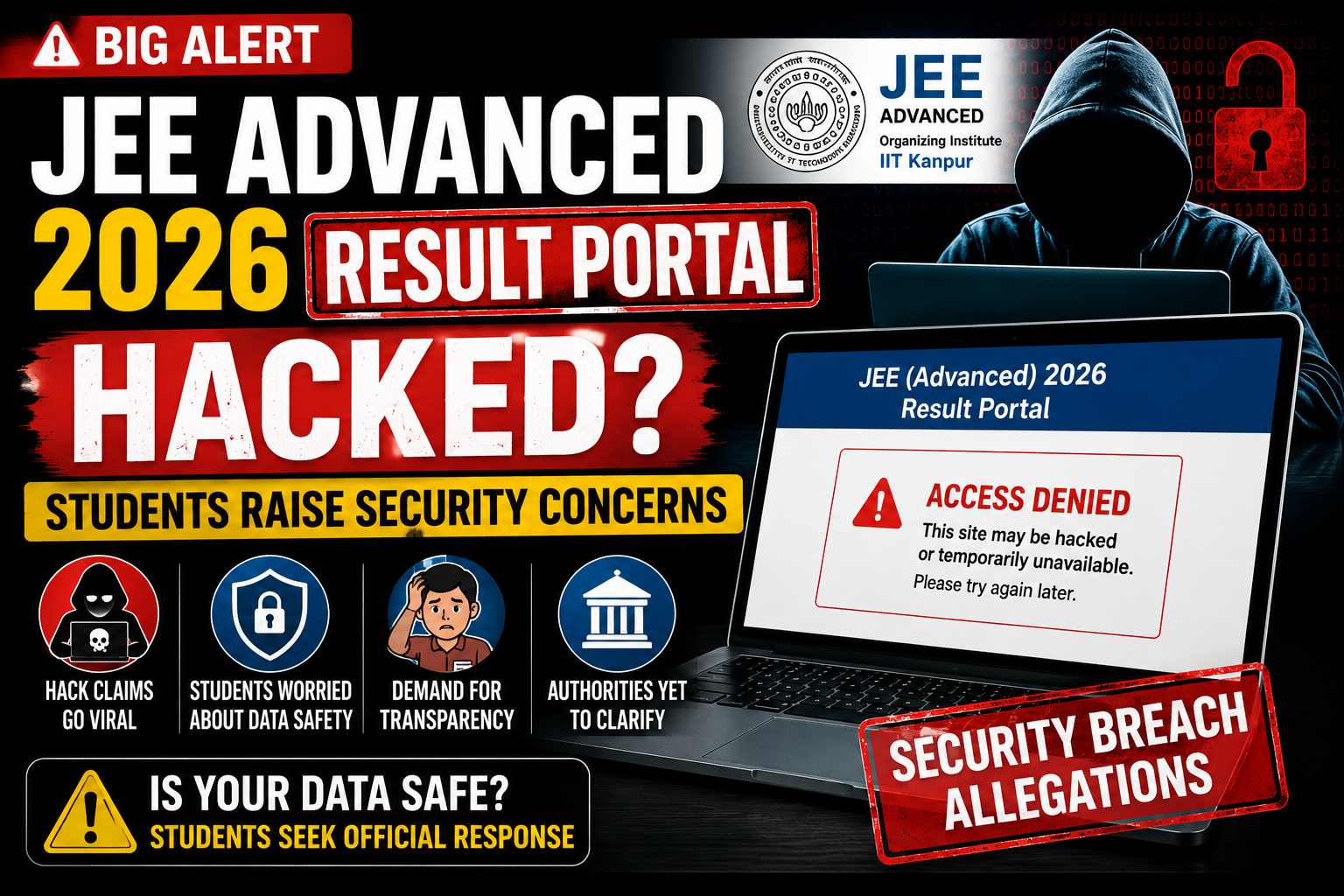
The Joint Entrance Examination (JEE) Advanced stands as one of the most prestigious and challenging competitive exams globally. However, a massive controversy erupted shortly after the declaration of results. Consequently, the phrase JEE Advanced 2026 Result Portal Hacked? Students Raise Security Concerns quickly became a trending topic across various social media platforms. Furthermore, reports of a significant data exposure involving lakhs of engineering aspirants sent shockwaves through the academic community. These developments raised serious questions regarding the digital safety of the premier examination infrastructure in India.
The Allegations: JEE Advanced 2026 Result Portal Under Fire
A cybersecurity researcher initiated the controversy on June 2, 2026. This happened exactly one day after IIT Roorkee officially announced the results. Specifically, the researcher revealed a critical vulnerability within the results infrastructure on X (formerly Twitter). According to these claims, an unsecured Amazon Web Services (AWS) cloud storage bucket backed the subdomain cdata.jeeadv.ac.in. Notably, the authorities used this specific subdomain to host result records and admit cards for the candidates.
Moreover, this misconfiguration allowed anyone with basic networking tools to list, enumerate, and bulk-download sensitive candidate data. Because the system required no authentication, the data remained accessible to the public. As a result, the JEE Advanced 2026 Result Portal Hacked? Students Raise Security Concerns narrative gained rapid momentum. Technical details of the “open directory” began circulating among tech-savvy students and experts almost immediately.
| Key Details of the Alleged Exposure | Impacted Data |
| Total Result Records | ~179,000 |
| Total Admit Cards | ~188,000 |
| Exposed Information | Candidate Names, DOB, Mobile Numbers, and Subject-wise Marks |
| Vulnerability Type | Public Cloud Storage Misconfiguration (Unsecured AWS Bucket) |
Students Raise Security Concerns Over Data Privacy
For the 1.79 lakh candidates who sat for the exam, the news of a potential data leak represents a total nightmare. Furthermore, the exposed data included highly personal information such as mobile numbers and dates of birth. Consequently, students have been vocal about their fears on platforms like Reddit and X. Many individuals worry that malicious actors will now sell their personal details to secondary phishing schemes.
In addition, many fear that unauthorized educational marketing databases will harvest this information. The JEE Advanced 2026 Result Portal Hacked? Students Raise Security Concerns issue remains particularly sensitive because coaching institutes often use this data to claim ranks. Similarly, scammers might target high-achieving students with fraudulent offers or identity theft attempts. Therefore, the student community is demanding immediate accountability from the organizing institute.
“We work hard for years to secure a seat in an IIT. However, seeing the organizing institute treat our personal data so carelessly is both heartbreaking and terrifying.” — A JEE Advanced 2026 Aspirant on Reddit
Technical Breakdown: Was it a Hack or a Leak?
While the public is widely using the term “hacked,” cybersecurity experts clarify that the incident was actually a data exposure. Specifically, a misconfiguration caused the leak rather than a traditional hack where an intruder forcibly breaches a secure system.
The researcher pointed out that the administrators left the ListObjectsV2 function on the AWS bucket enabled for the public. Consequently, this made the root directory of the results database “listable.” This allowed any outsider to see the names of all files, including PDFs of scorecards and admit cards. Furthermore, they could download these files directly to their local machines. Experts consider this type of oversight a “rookie mistake” in cloud deployment. Nevertheless, such errors can have catastrophic consequences when they involve national-level sensitive data.
Moreover, observers have compared this incident to the recent CBSE On-Screen Marking (OSM) controversy. In that case, researchers also reported similar vulnerabilities. Therefore, the recurring nature of these digital lapses in Indian education boards has intensified the JEE Advanced 2026 Result Portal Hacked? Students Raise Security Concerns debate across the country.
IIT Roorkee’s Response and Mitigation Steps
Following the public disclosure of the vulnerability, network administrators acted quickly to secure the infrastructure. Specifically, they updated the IAM (Identity and Access Management) permissions on the AWS bucket. This action disabled public execution privileges and blocked unauthorized access.
Currently, the portal has returned to its standard verified login process. Consequently, candidates must now enter their registration sequence and date of birth to access their results. However, the Joint Admission Board (JAB) and IIT Roorkee have yet to issue a formal public statement. They have not confirmed whether any automated “scrapers” successfully extracted the bulk data before the fix. Despite this, the authorities maintain that the portal is now secure for all users.
The Broader Impact on National Competitive Exams
The JEE Advanced 2026 Result Portal Hacked? Students Raise Security Concerns episode occurs at a critical time. India is already grappling with controversies surrounding paper leaks in other major exams like NEET-UG. Although the shift toward Computer-Based Testing (CBT) aimed to bring more security, these incidents suggest otherwise. Specifically, they show that digital infrastructure remains just as vulnerable as physical systems if administrators do not manage them with extreme rigor.
What Should Students Do Now?
If you are a JEE Advanced 2026 candidate, experts suggest taking the following precautions:
1.Be Wary of Phishing: Be cautious if you receive unsolicited calls from coaching centers. Similarly, ignore “IIT admission consultants” who ask for personal details.
2.Monitor Your Accounts: Regularly check for any unauthorized attempts to access your email. In addition, stay alert for any suspicious activity on your linked services.
3.Check Official Updates: Only trust information that comes from the official JEE Advanced website.
Conclusion
The JEE Advanced 2026 Result Portal Hacked? Students Raise Security Concerns controversy serves as a major wake-up call. As educational institutions move toward a fully digital ecosystem, they must prioritize the safeguarding of student data. Whether the incident was a “hack” or a “misconfiguration,” the result remains the same: the trust of the nation’s brightest minds has been shaken. Therefore, the authorities must not only fix the technical glitches but also provide a transparent explanation. Ultimately, the futures and data of millions of students depend on robust and secure digital systems.
References & External Links:
•Official JEE Advanced 2026 Website
•LatestLY: JEE Advanced 2026 Candidates’ Data Exposed
•Times of India: NTA Re-Exam Portal Under Scanner
Also read: NTA Re-Exam Portal Hacked? Data Leak Alert

One thought on “JEE Advanced 2026 Result Portal Hacked? Students Raise Security Concerns”